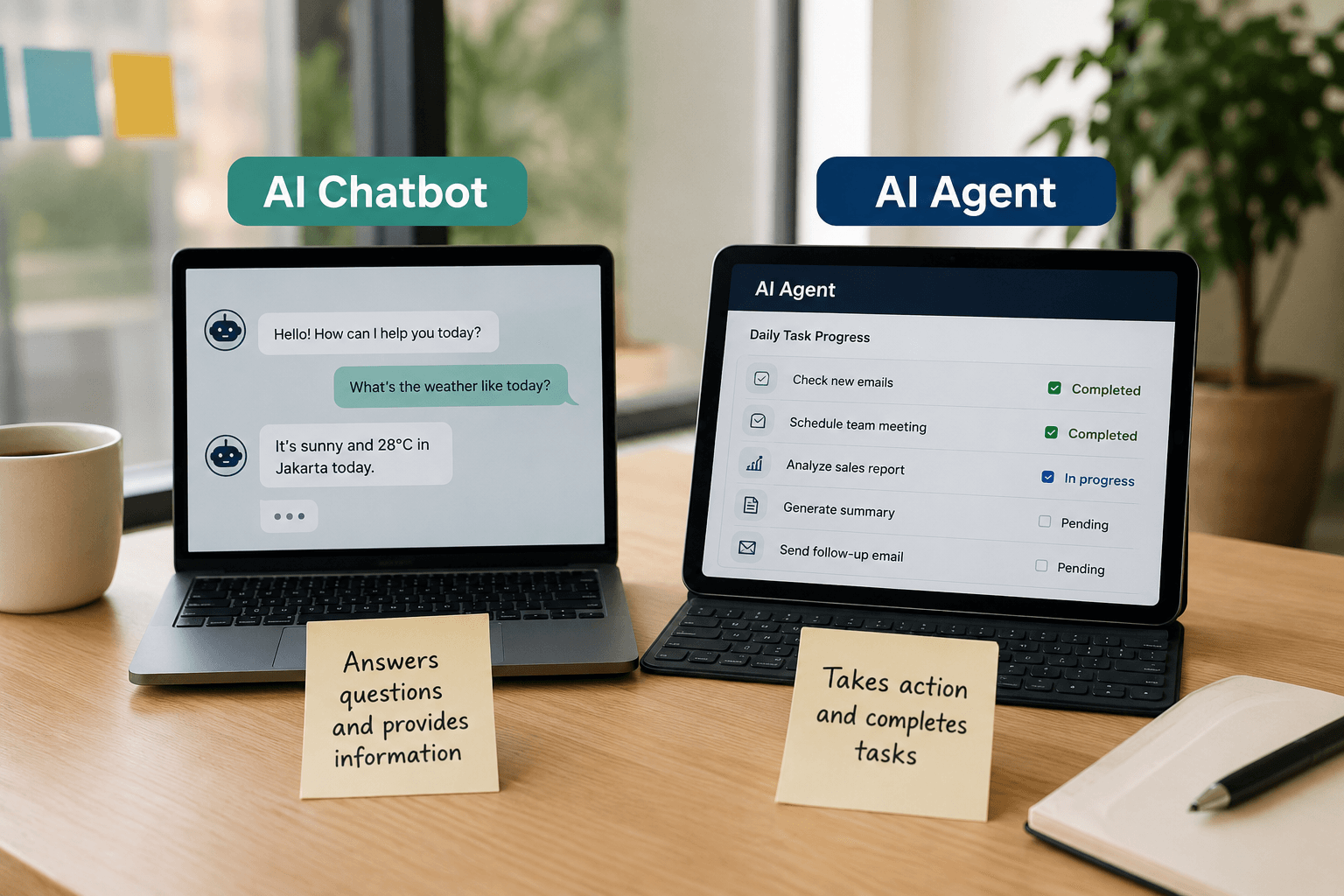

For years, chatbots have been the go-to solution for businesses looking to automate customer interactions. They answer frequently asked questions, assist customers 24/7, and reduce the workload of customer support teams.
But as artificial intelligence rapidly evolves, many organizations are realizing that answering questions is no longer enough.
Modern businesses need AI systems capable of taking action, making decisions, and completing complex workflows—not just responding with text. This is where AI Agents come in.
Unlike traditional chatbots, AI agents can understand goals, plan multiple steps, interact with business applications, and execute tasks autonomously while keeping humans in control when needed. As enterprise AI adoption accelerates, AI agents are becoming one of the most significant technological shifts since the introduction of conversational AI. According to Microsoft, AI agents are designed to operate independently, collaborate with users, and automate complex business processes across multiple systems.
What Is a Chatbot?
A chatbot is an application designed to simulate conversations with users through text or voice. Modern chatbots often use Large Language Models (LLMs) and Natural Language Processing (NLP) to generate more natural responses.
Most chatbots are built to assist users with specific interactions, such as:
- Answering frequently asked questions
- Providing product information
- Booking appointments
- Tracking orders
- Handling basic customer support
While today's AI-powered chatbots are significantly more advanced than rule-based bots, they are still primarily focused on conversation rather than execution. According to IBM, chatbots help organizations improve customer service by automating repetitive interactions while reducing operational costs.
What Is an AI Agent?
An AI Agent goes one step further. Instead of only responding to prompts, an AI agent is designed to achieve a goal. It can analyze requests, plan multiple actions, interact with different applications, and execute tasks with minimal human intervention.
For example, an AI agent could:
- Retrieve information from a CRM
- Generate a sales report
- Send follow-up emails
- Schedule meetings
- Update internal databases
- Trigger approval workflows
Rather than acting as a conversational assistant, AI agents function more like digital coworkers capable of completing business processes. Microsoft describes AI agents as systems that can plan, act, and collaborate to accomplish objectives across connected applications.
When Should You Use a Chatbot?
A chatbot is still the right solution if your primary goal is improving customer communication.
Typical use cases include:
- Customer support
- Frequently asked questions
- Website virtual assistants
- Lead generation
- Appointment booking
Because chatbots are relatively easy to deploy, they remain one of the most cost-effective AI solutions for many organizations.
When Should You Consider an AI Agent?
If your business processes involve multiple steps, approvals, or systems, an AI agent may deliver greater value.
Common enterprise use cases include:
- Employee onboarding
- IT helpdesk automation
- HR request management
- Sales operations
- Procurement workflows
- Report generation
- Internal knowledge management
Instead of simply answering a request, an AI agent can execute the entire workflow from start to finish.
Chatbots and AI agents are not competing technologies—they solve different problems.
Chatbots excel at improving conversations with customers and employees, while AI agents extend those capabilities by automating complex business workflows and supporting decision-making.
As AI continues to evolve, organizations should focus less on adopting the latest technology and more on choosing solutions that align with their business objectives. For many businesses, the future isn't about replacing chatbots with AI agents—it's about combining both to create smarter, more efficient digital experiences.
Looking to Build AI Solutions for Your Business?
At Meda Technology, we help organizations design and develop AI-powered solutions tailored to their business needs—from intelligent chatbots that enhance customer engagement to AI agents that automate complex workflows.
Whether you're exploring AI for the first time or scaling existing initiatives, our team can help you build practical, secure, and future-ready solutions. Let's build AI that delivers real business value.